
Prehistoric Programs
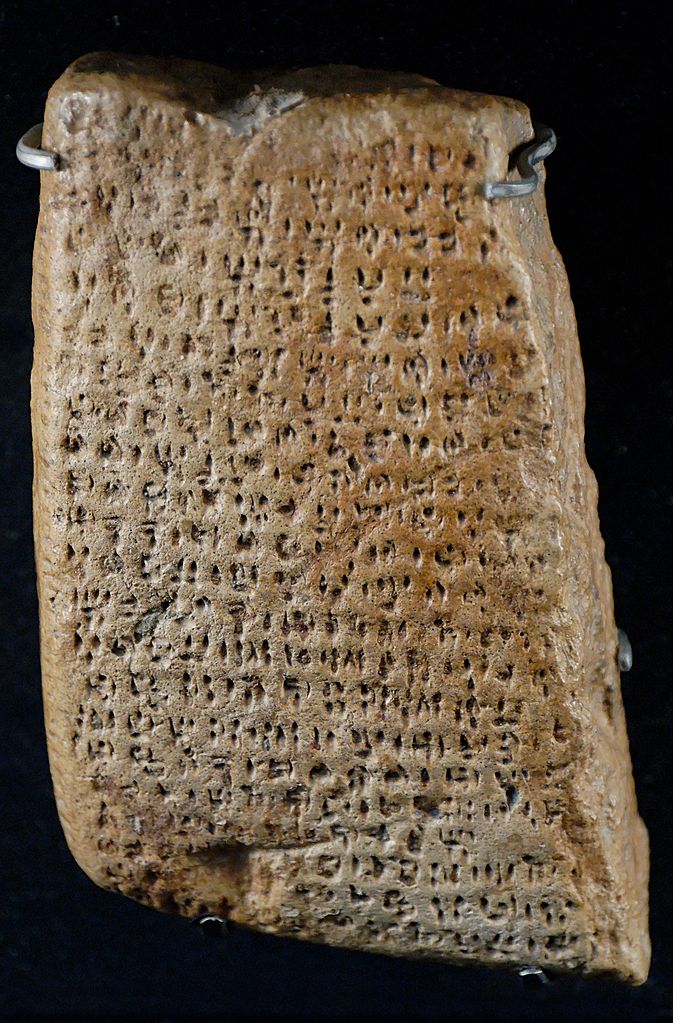

Taken together, the tablets appear to describe a great piece of work – perhaps a program, or an epic, or even tax records! Unsurprisingly, after such a long time, the tablets are in a state of disorder. Your job is to arrange them into a sequence so that the resulting work has a properly nested parenthesis structure. Considering only opening and closing parentheses, a properly nested structure is either
-
(), or
-
($A$), where $A$ is a properly nested structure, or
-
$AB$, where $A$ and $B$ are properly nested structures.
Input
The first line of input contains one integer $n$ ($1 \leq n \leq 10^6$), the number of tablets. Each of the remaining $n$ lines describes a tablet, and contains a non-empty string of opening and closing parentheses; symbols unrelated to the nesting structure are omitted. The strings are numbered from $1$ to $n$ in the order that they appear in the input. The input contains at most $10^7$ parentheses.
Output
Output a permutation of the numbers from $1$ to $n$ such that concatenating the strings in this order results in a properly nested structure. If this happens for multiple permutations, any one of them will be accepted. If there is no such permutation, output impossible instead.
| Sample Input 1 | Sample Output 1 |
|---|---|
2 ())())() ((() |
2 1 |
| Sample Input 2 | Sample Output 2 |
|---|---|
5 ( )) (( )) ( |
1 5 3 2 4 |
| Sample Input 3 | Sample Output 3 |
|---|---|
2 (( ) |
impossible |